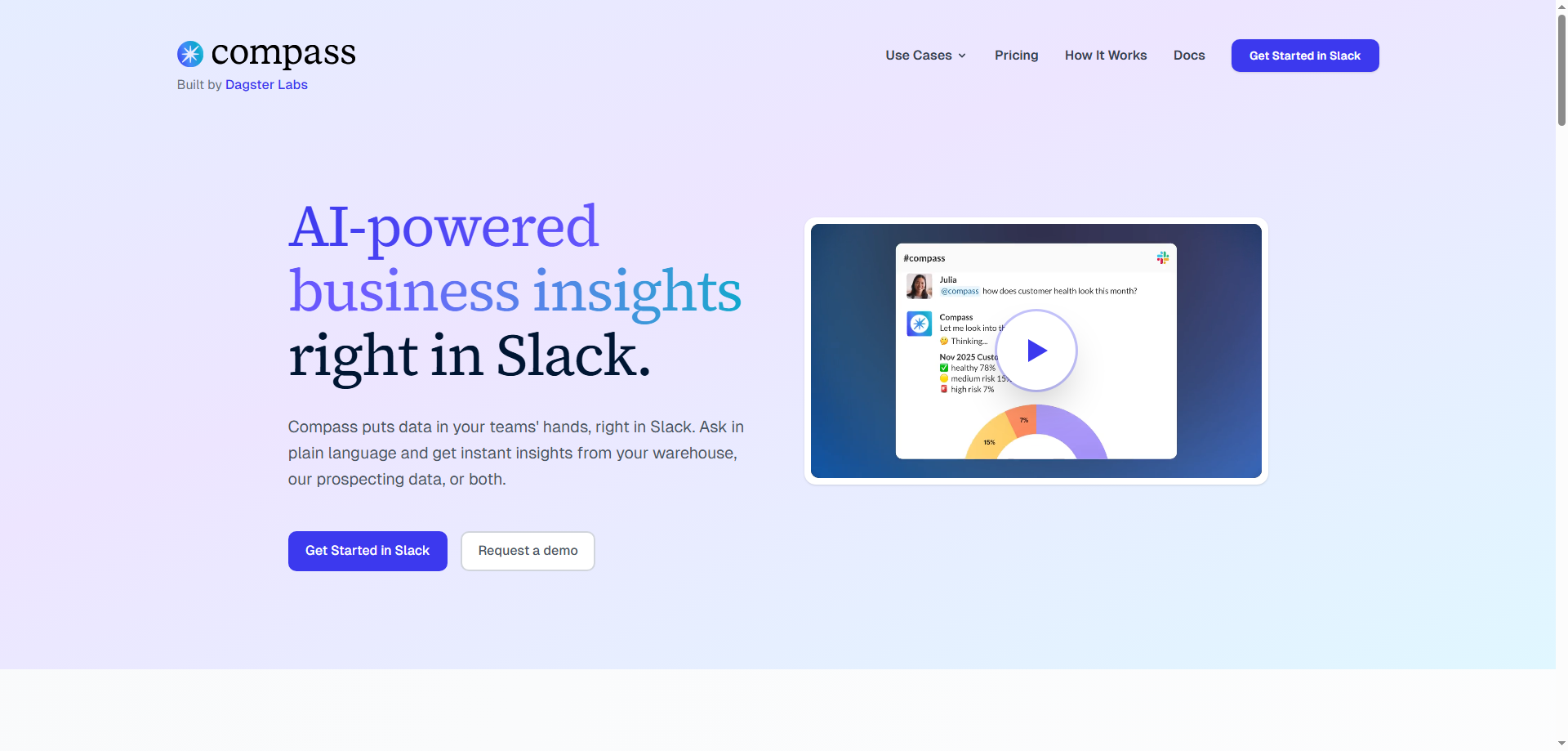
In today’s fast-paced business environment, time is a luxury. Especially when you need quick insights from your data, the last thing you want is to sift through endless spreadsheets or complex queries. Enter Compass, a game-changing tool that brings data right into your Slack conversations. This product acts as a smart data assistant, making it easy for teams to ask questions in natural language and receive instant answers directly from their data warehouse or CRM. With Compass, you can forget about learning complicated query languages. Just type your question, and Compass does the rest.
What’s even more exciting is that Compass doesn’t just streamline how you access data—it integrates seamlessly into your everyday workflows. Imagine asking your team, “How did we perform in sales last month?” in Slack, and getting the exact figures or even a visual chart within seconds. Whether you're tracking sales funnels, searching for new leads, or just checking in on customer data, Compass ensures you’re always one step ahead in making data-driven decisions without breaking your flow.
A Creative Take: How Compass Redefines Data Access
What makes Compass truly creative is its ability to simplify the complex process of querying and analyzing data. Instead of navigating through clunky data dashboards or relying on technical staff to generate reports, Compass lets you ask questions in the same way you would with a colleague. This conversational approach to data analysis is revolutionary because it eliminates the need for specialized knowledge or external tools.
Consider this: Most business intelligence platforms require a steep learning curve, particularly for non-technical users. You need to understand database structures, query languages, and often use a separate application to access insights. Compass flips this model on its head. It lives right where your team is already collaborating—inside Slack—and you interact with it just as you would any other chatbot. This simplicity lowers the barrier to data accessibility, empowering every team member, from sales reps to product managers, to ask the right questions and make informed decisions without waiting for data specialists.
By using natural language processing, Compass also allows your team to stay focused on the task at hand, without having to open a new tool or interface. It’s like having an intelligent data assistant available at all times, ready to help you find answers to critical business questions—instantly.
Disruption: Can Compass Replace Traditional Data Platforms?
When viewed through the lens of disruption, Compass stands out as a potential game-changer for traditional data analysis tools. Most business intelligence and data management platforms require dedicated dashboards, training, and often, external applications to pull insights. This process can be time-consuming, especially for teams without dedicated data analysts. Compass, on the other hand, brings data analysis directly into Slack, making it easier for anyone in the organization—whether technical or non-technical—to get the answers they need.
Can Compass replace existing platforms? In some ways, absolutely. For teams that rely on quick, actionable insights rather than in-depth data visualizations, Compass offers a simpler, more integrated solution. It’s particularly useful for teams that don’t need to dive into complex data analysis but instead need fast, accurate information to make day-to-day decisions.
However, there are limits. Compass doesn’t replace the need for more robust analytics platforms for in-depth reporting or long-term data trends. Instead, it complements these tools by providing instant, on-demand insights in the natural flow of daily communication. The key here is that Compass isn’t trying to replace your existing tools—it’s enhancing the accessibility and speed of data insights within your existing team environment.
For companies looking to streamline their data access and foster a more collaborative environment, Compass could easily become the go-to solution for day-to-day data queries, freeing up more technical resources to focus on strategic tasks.
User Demand: How Will Teams React to Compass?
From a user demand perspective, Compass addresses a very clear need for teams that rely on quick, real-time insights but are bogged down by complex tools. In modern business environments, teams are often scattered, working across different tools and applications, leading to delays and disjointed communication. Compass streamlines this process by allowing teams to use a single tool—Slack—to get answers to all their data-related questions.
Users will appreciate Compass for several reasons:
- Simplicity: No need for technical expertise. Teams can ask questions using natural language, making it easy for anyone to access the data they need.
- Speed: The tool provides instant responses, allowing teams to make quick decisions without waiting for lengthy report generation or relying on IT support.
- Efficiency: Integration within Slack eliminates the need to switch between multiple apps, keeping teams focused and efficient without breaking their workflow.
- Collaboration: By bringing data into the conversations, Compass fosters a collaborative work environment where everyone has equal access to valuable insights.
For sales teams, marketing teams, product managers, or even customer support, Compass offers a powerful yet simple tool to access insights that can drive faster decision-making. Whether you’re tracking sales performance or understanding customer behavior, Compass’s natural language query system ensures that no one has to wait for a report to come back before moving forward with critical decisions.
Scoring Compass’s Future: Will It Survive the Next Year?
1-Star to 5-Star Evaluation:
Now, let’s break down Compass’s potential over the next year based on several key factors:
-
Ease of Use (Rating: 5/5): The biggest advantage of Compass is its simplicity. By integrating directly into Slack and allowing users to ask questions in natural language, it ensures that teams, regardless of technical ability, can easily access critical business data.
-
Market Demand (Rating: 5/5): The demand for accessible data insights is growing, especially as more teams look to make data-driven decisions quickly. Compass taps into this need perfectly by eliminating barriers to data access and enabling instant insights.
-
Innovation and Differentiation (Rating: 4/5): Compass brings a fresh perspective to how teams interact with data. Its integration within Slack and use of natural language makes it unique in a crowded field of business intelligence tools. However, it still faces competition from established data platforms, so it will need to continue innovating to stay ahead.
-
Scalability (Rating: 3/5): While Compass is great for real-time insights and smaller-scale operations, it may struggle to scale for larger enterprises with more complex data needs. For bigger organizations, the need for more detailed, long-term reporting might overshadow the immediate value Compass offers.
-
Long-Term Viability (Rating: 4/5): Compass is well-positioned for the next year, but its long-term success will depend on how well it evolves. Its ability to integrate with other business intelligence platforms or expand its functionality will play a big role in its future.
Risks and Opportunities:
Risks:
- Market Saturation: The data analysis and business intelligence space is already crowded. Compass will need to continue to differentiate itself to avoid getting lost in the noise.
- Scalability Challenges: While Compass is perfect for small-to-medium teams, larger companies with more complex data may find it lacking in terms of depth and long-term trend analysis.
Opportunities:
- Wider Integration: Expanding its integrations beyond Slack to other collaboration platforms like Microsoft Teams could help Compass reach a larger audience.
- Advanced Features: By adding more advanced data visualization options or enhanced customization features, Compass could increase its appeal to more sophisticated users while maintaining its ease of use.
Conclusion
Compass has a lot of potential, particularly for teams looking to make quick, data-driven decisions without the complexity of traditional data platforms. Its ability to integrate into Slack and provide real-time answers using natural language queries makes it a strong contender in the world of business intelligence. Given its focus on simplicity and speed, Compass is well-positioned to thrive in the next year, with a solid 4/5 rating. However, to ensure long-term success, it will need to continue evolving and differentiating itself in the competitive landscape of data tools.