1. Eureka’s Creative Angle: A New Era in Knowledge Visualization
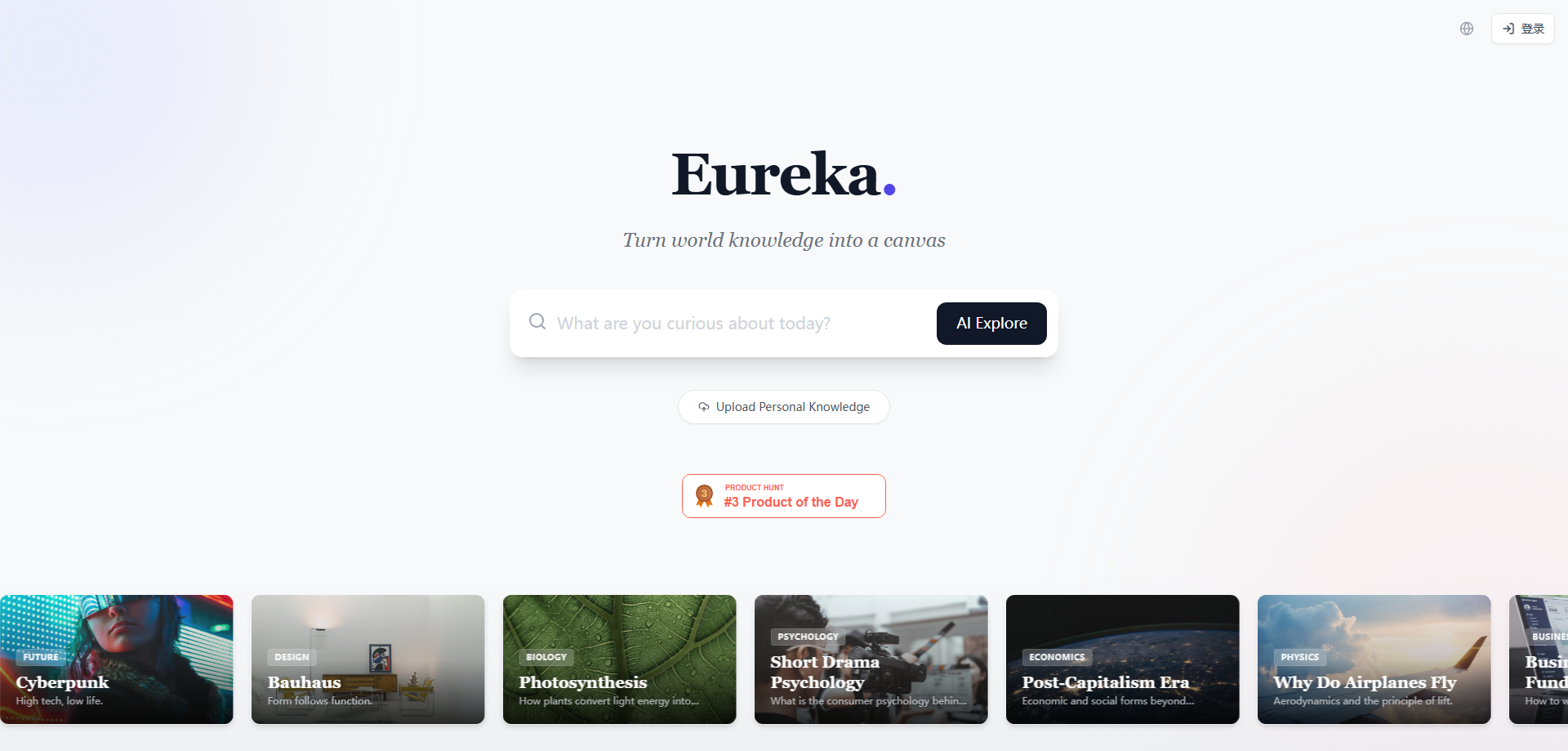
Eureka is an absolute game-changer when it comes to how we process information. Traditionally, we’ve relied on linear reading to digest content—think textbooks, research papers, articles—just pages of text to sift through. While this works, it’s not always the most efficient way to absorb or organize complex ideas. Enter Eureka, the AI-powered tool that reimagines knowledge exploration by transforming linear text into dynamic, interactive, visual knowledge maps.
Instead of reading through lengthy research papers or textbooks, Eureka turns them into beautiful, interactive graphs that show how concepts relate to each other. Think of it like a mind map on steroids—each concept, each point, each relationship is visualized in a way that you can explore. Whether it's through nodes, timelines, or concept trees, Eureka brings clarity to even the most complex subjects.
Let’s break it down with a simple example: say you’re trying to understand quantum physics. Just type the topic into Eureka or upload a PDF about it, and Eureka’s AI will automatically generate a visual map that shows you the interconnectedness of quantum mechanics’ core principles. You can zoom in on specific concepts, explore how they relate to one another, and get a sense of the bigger picture—all without having to read through multiple chapters or articles. Eureka takes the mental load off and gives you a much clearer, more engaging way to grasp tough topics.
2. Disrupting the Existing Landscape: Can Eureka Replace Traditional Tools?
The question here is: can Eureka replace traditional tools like textbooks, notes, or research databases? The short answer is: absolutely, in certain contexts.
Let’s face it—research papers, textbooks, and lecture notes can be incredibly dense. You may spend hours reading through them, trying to piece together how different topics interconnect, only to realize that you missed a critical link somewhere. Traditional methods of learning and studying don’t always prioritize the relationships between concepts—they focus more on the details in isolation.
This is where Eureka disrupts the traditional approach. By transforming linear reading into interactive visual maps, Eureka allows users to see the connections and relationships between ideas right from the get-go. It doesn't just throw information at you—it organizes it into an interconnected, easily explorable structure. This could completely change how we approach learning and researching, especially for subjects that are inherently complex.
That said, Eureka might not fully replace traditional textbooks or papers, especially for deep academic research where thorough reading and citation are essential. However, it can absolutely complement these resources by providing an interactive, visual summary of key ideas, helping users organize their thoughts and identify patterns they might have missed.
Eureka’s biggest potential as a disruptor lies in academic settings, research and development industries, and even in corporate environments where large amounts of information need to be synthesized quickly. It’s ideal for anyone who needs to process a lot of information at once, but doesn't want to spend hours just reading through dry, text-heavy sources.
3. Eureka’s Clear Value Proposition: Meeting Users' Needs
So, what do users need from a product like Eureka? First and foremost, they need something that makes the process of learning and organizing complex information easier and more intuitive. Eureka solves that problem by allowing users to convert dry, complex content into interactive maps that make it easier to grasp, remember, and explore.
Think about students, researchers, and professionals who need to process large amounts of information quickly. They can upload a PDF or input a topic, and Eureka generates a visual map that gives them a much clearer overview of the material. This can significantly reduce the time it takes to understand complex subjects. Eureka’s interactive features let users dig deeper into specific concepts, while its overall design makes it easy to see how everything connects. This creates an experience that feels more like exploring a new subject than slogging through pages of unorganized text.
The real beauty of Eureka lies in its ability to adapt to different kinds of users. Whether you’re a student studying for exams, a researcher diving into a new topic, or a professional trying to make sense of market trends, Eureka makes it easier to navigate and understand information. It's not just for those with a specific background—it’s for anyone who needs to grasp complex ideas and visualize relationships between them.
Eureka’s core function—to simplify the understanding of complex information—is directly aligned with a very real need. People today are overloaded with information, and often, the challenge isn’t finding the data—it’s understanding it and making sense of how different pieces fit together. Eureka addresses this need head-on, offering a product that enhances learning, aids in research, and provides users with a better, more efficient way to process information.
4. Rating Eureka’s Future: Can It Survive and Thrive in the Next Year?
As with any new product, predicting Eureka’s future is both exciting and uncertain. To evaluate its potential for the next year, let’s rate it on a scale of 1-5 stars, considering various aspects like market demand, competition, and potential risks and opportunities.
Rating: 4/5 Stars
Eureka shows immense promise. Its unique approach to knowledge visualization sets it apart from traditional tools, and its AI-powered ability to turn complex information into digestible, interactive maps is an innovation that’s sure to appeal to a wide range of users. The potential market for Eureka is vast, spanning students, researchers, and professionals across various industries, from academia to business analytics.
Risks:
-
Market Education: Eureka’s concept may take time to gain traction. Users who are accustomed to traditional reading and study methods may initially struggle to see the value of a visual knowledge map. Educating the market and convincing users to adopt a new approach will be key.
-
Dependence on Quality Input: While Eureka can generate fantastic results from well-structured content (like PDFs or specific topics), the quality of the output depends heavily on the quality of the input. If the uploaded content is poorly structured, Eureka’s maps might not be as useful.
-
Competition from Existing Tools: Eureka faces competition from other mind-mapping tools, AI-driven research assistants, and even traditional academic tools. It will need to continuously innovate to stay ahead of the competition.
Opportunities:
-
Wide Adoption Across Education: Eureka has the potential to revolutionize how students study, making learning more engaging and efficient. If marketed well to educational institutions, Eureka could become a staple in classrooms and study routines.
-
Expansion into Corporate and Research Industries: Beyond individual users, Eureka can be a game-changer in industries like research and development, market analysis, and corporate strategy. The ability to quickly organize and visualize information would provide immense value in these fields.
-
Integration with Existing Platforms: Eureka could partner with academic platforms, research databases, or learning management systems to expand its user base and make its visual knowledge maps a part of daily workflows.
Conclusion
Overall, I would rate Eureka at 4 out of 5 stars for the next year. While it faces some risks, particularly in market education and competition, it also has significant opportunities in the education sector, corporate world, and research fields. If Eureka continues to innovate and refine its product, it has the potential to become an indispensable tool for anyone looking to process, understand, and organize complex information.
The future is bright for Eureka, but its success will depend on how well it navigates user adoption and stays ahead of its competitors. Let’s see how it unfolds!