Introduction
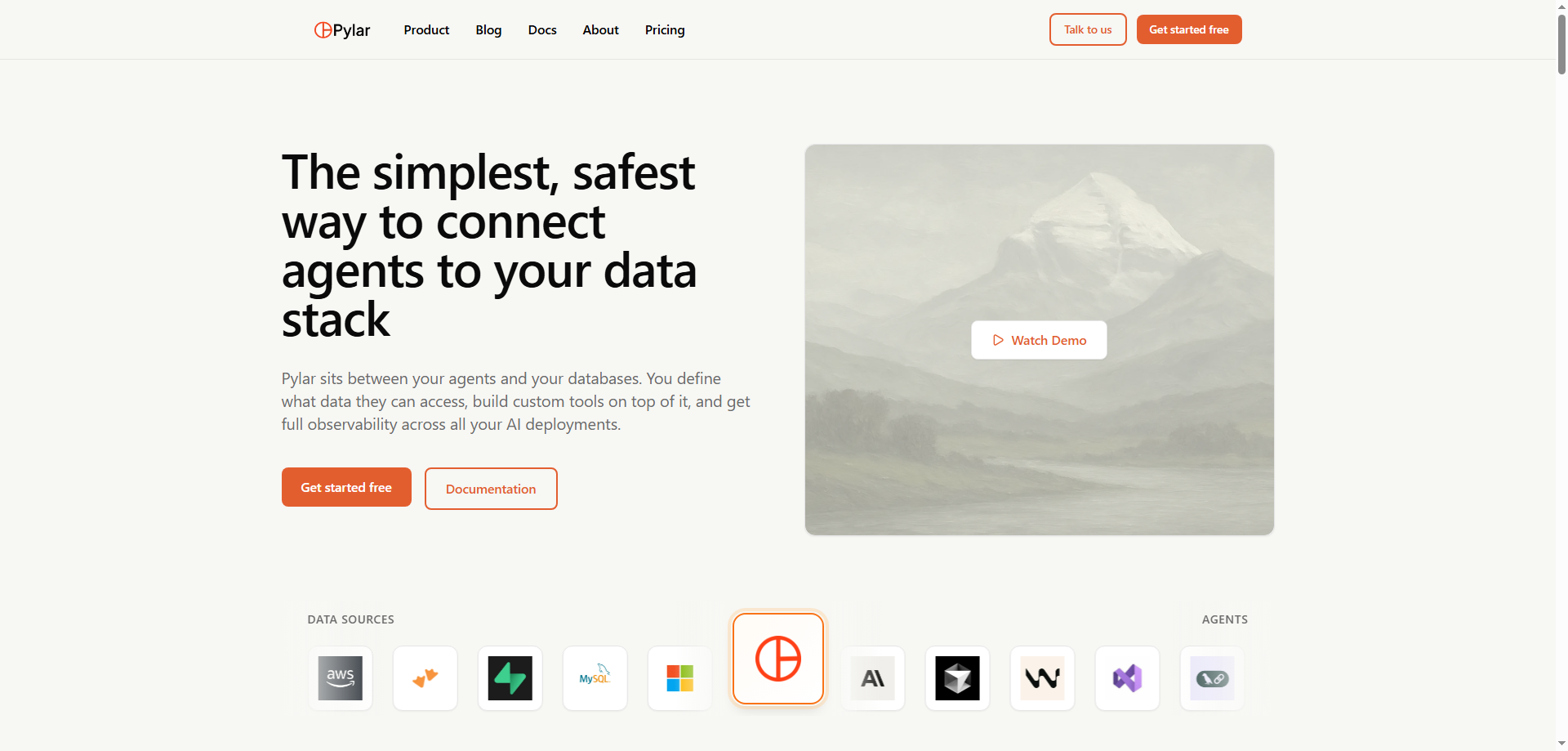
In today's world, where data security is more critical than ever, Pylar offers a groundbreaking solution for seamlessly connecting your data stack to AI agents. Think of it as a "smart security checkpoint" for your data. Pylar ensures that AI (or what we call "agents") can access only the specific information they need, without compromising sensitive data. Whether you’re an AI developer or a business leader, this product takes the guesswork out of data security and control, ensuring that your data remains safe while still being useful for AI-driven tasks.
A Creative Perspective: What Makes Pylar Special?
At its core, Pylar isn’t just another tool for data management. It’s a creative way to ensure that your data stack interacts with AI in a secure, customizable, and effective manner. The innovation here lies in the product’s ability to define "views" for AI agents. These "views" act like windows into the data, allowing AI to access just the information it needs to complete its tasks. Imagine it like providing an AI agent with a specific "zoomed-in" view, preventing it from seeing the entire data set, especially sensitive or confidential information.
What makes Pylar stand out is how customizable it is. You can decide what data an agent should access, and you can even craft a personalized "MCP tool" (a tool that packages your defined data views) for seamless integration into any AI development environment. This allows for greater control over what the AI sees and does, all while maintaining high levels of observability for security and compliance.
The Disruptive Potential: Can Pylar Replace Existing Products?
Looking at Pylar through a disruptive lens, the product has the potential to overhaul how companies handle sensitive data in AI applications. Traditionally, connecting AI to data stacks involves either giving the agent full access to all data or using complex, often error-prone methods to limit access. This can be a significant challenge, especially when handling sensitive information such as financial records or healthcare data.
Pylar disrupts this by offering a highly flexible system where access is granular, and the AI is only able to see what you want it to. No longer do you have to worry about compromising data privacy or spending hours configuring complicated access protocols. With Pylar, you can deploy a safer, more efficient system for AI interactions.
While existing tools may allow for some level of data access control, none offer the seamless integration and fine-tuned security Pylar provides. This makes Pylar a potential game-changer in industries where data security is paramount, such as finance, healthcare, and legal services.
But can Pylar fully replace other data connection tools? It’s possible. However, its success will depend on how well it is adopted by businesses that need to manage sensitive data. For now, it provides a robust alternative that could eventually become the standard for AI integrations in data-sensitive environments.
User Acceptance: How Will People React to Pylar?
From the perspective of user needs, Pylar addresses a very real and growing concern in data security. Businesses and developers are increasingly looking for ways to ensure AI agents can interact with data without compromising privacy or security. Pylar offers a straightforward solution to this problem by allowing users to define exactly what data their AI agents can access, making it an attractive proposition for anyone working with sensitive information.
Users, especially those in industries like finance, healthcare, and law, are likely to appreciate the level of control Pylar offers. For example, a financial analyst can create a custom view for an AI agent that allows it to analyze market trends without exposing customer account details. Similarly, a medical researcher can provide AI access to specific disease-related data, while safeguarding patient privacy.
However, the product’s acceptance will depend on how easy it is for users to integrate it into their existing workflows. If Pylar can streamline the process of setting up these custom views and integrating with existing AI development platforms, it will gain traction quickly. For users already concerned with data security, the promise of Pylar’s fine-tuned data access control will be highly appealing.
Scoring Pylar’s Future: Can It Thrive in the Coming Year?
1-Star to 5-Star Evaluation:
Let’s break down the key factors that will determine Pylar’s chances of success in the next year:
-
Ease of Integration (Rating: 4/5): Pylar’s ability to integrate seamlessly into any AI development platform is a huge selling point. However, it’s important to ensure that the setup process remains user-friendly and doesn’t require heavy technical expertise. Simplifying this process further could boost adoption.
-
Security and Data Control (Rating: 5/5): Pylar excels in providing a high level of data security by allowing businesses to define exactly what data AI agents can access. This is a critical feature, especially as data privacy regulations become stricter worldwide.
-
Market Demand (Rating: 4/5): As businesses increasingly rely on AI for data analysis, the demand for secure and manageable AI data connections will likely grow. Pylar is well-positioned to meet this demand, but it will need to educate potential users about the benefits of granular data access control.
-
Competitive Landscape (Rating: 3/5): The AI and data security space is crowded, with numerous players offering similar solutions. Pylar will need to differentiate itself further by showcasing its unique features, particularly in terms of customization and observability.
-
Future Potential (Rating: 4/5): If Pylar continues to evolve, it could become the go-to tool for businesses managing sensitive data. It offers a creative solution to a pressing need in data security, and as AI usage continues to grow, so too will its potential.
Risks and Opportunities:
Risks:
- Complexity for Non-Technical Users: If Pylar doesn’t continue to refine its user interface and make it easy for non-technical users to set up and manage data access controls, it may face resistance from businesses without dedicated technical teams.
- Competition: The market for AI security tools is highly competitive, and larger companies may enter the space with more extensive resources or better-known brands, making it harder for Pylar to stand out.
Opportunities:
- Increasing Data Privacy Concerns: As data privacy regulations tighten and companies become more sensitive to the risks of data breaches, Pylar’s focus on secure data access and observability could position it as an indispensable tool.
- Expansion into New Industries: While Pylar is already useful in finance and healthcare, its potential use cases in other industries such as legal and retail could broaden its customer base significantly.
Conclusion
Overall, Pylar seems poised for success in the coming year, particularly in industries that handle sensitive data. Its unique approach to data security and AI integration sets it apart from the competition. With a few adjustments to ease of use and continued innovation, Pylar could thrive in a rapidly growing market. On a scale of 1-5 stars, I’d rate it a solid 4 for its future potential and immediate relevance in addressing AI security needs.