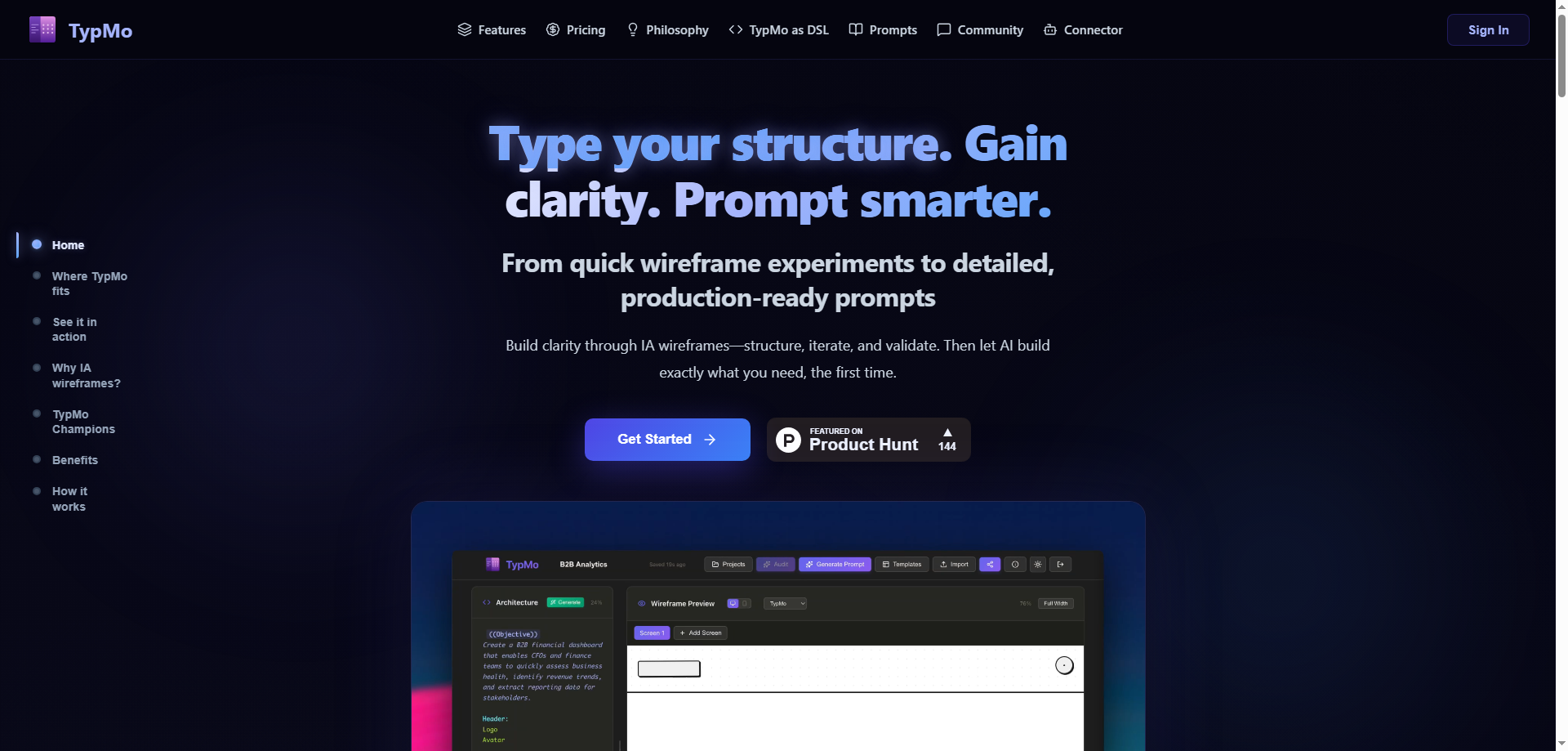
As a product manager, designer, or developer, one of the most challenging parts of bringing a product to life is translating abstract ideas into functional UI designs and clear development instructions. That’s where TypMo comes in—a revolutionary tool that allows you to convert your thoughts into UI wireframes and AI programming prompts without the need for complex design software.
Think of TypMo as a powerful bridge between concept and implementation. You can create detailed wireframes using simple Markdown-like syntax or transform rough sketches into professional wireframes. With over 60 pre-built UI components to choose from, you don’t need design expertise to get started. Additionally, TypMo helps you refine your designs and generates AI prompts for AI-assisted coding, ensuring faster development cycles. Whether you're working alone or in a team, TypMo streamlines the process of creating, iterating, and sharing your ideas, all while keeping the focus on clarity before code.
A Creative Perspective: How TypMo Simplifies UI Design and Iteration
From a creative standpoint, TypMo redefines how we think about UI design. Traditionally, UI design requires either complex software or a significant time investment in learning tools. TypMo eliminates these barriers by providing a text-based UI design solution that requires zero prior design knowledge. Instead of opening up a design tool, you write simple text that describes the interface, such as buttons, input fields, and navigation menus. TypMo instantly converts these into wireframes.
What makes TypMo even more creative is its ability to take hand-drawn sketches and convert them into clean, editable wireframes. This feature allows for quick iterations, making it ideal for fast-paced environments where time and resources are limited.
The most innovative aspect, however, is the integration of AI prompts. Once you've designed your UI, TypMo can convert the wireframe into precise AI-friendly prompts that help automate the coding process. This connection between design and development enhances workflow efficiency and cuts down on the time spent on manual coding.
With TypMo, you can focus more on design clarity and team collaboration without getting bogged down by complex design tools or waiting for manual feedback cycles.
Disruption: Can TypMo Replace Existing Design Tools?
In terms of disruption, TypMo has the potential to challenge traditional UI design tools and even workflow management platforms used by product teams. Let’s face it—most design software, like Figma or Adobe XD, can be overwhelming for people who just need a quick wireframe or a proof of concept. These tools often come with steep learning curves and require design expertise.
TypMo, on the other hand, offers a streamlined, no-learning-curve solution for rapid wireframing. The ability to generate UI layouts using simple text commands is a game changer, particularly for non-designers or those who don’t have access to a full design team. Additionally, the integration with AI coding assistants is a feature not commonly found in traditional design tools. This could significantly reduce the time between design and development by ensuring smoother transitions from wireframes to actual code.
While TypMo might not replace the more complex capabilities of traditional design software—like intricate animations or highly detailed visuals—it does provide a highly effective alternative for quick prototypes and product iterations. For teams that need to get ideas down quickly and move into development faster, TypMo could become the go-to tool.
The real disruptiveness comes from TypMo’s ability to accelerate product development, making it an ideal tool for fast-paced startups, independent developers, or product teams that need to iterate quickly without the overhead of complex design software.
User Demand: Will TypMo Gain Traction Among Teams?
From a user demand perspective, TypMo addresses several critical pain points in the design and development process. One of the biggest challenges in product development is ensuring that your initial designs are both clear and actionable for the development team. TypMo helps by offering a low-cost, high-efficiency solution for quick iteration and team collaboration.
For product managers and independent developers, TypMo simplifies the process of turning abstract ideas into tangible wireframes. The ability to sketch out an idea and then quickly share it with a team or convert it into a development prompt is a massive productivity booster. For teams that need to collaborate on product design and development, TypMo’s easy sharing and iterative design process foster faster feedback loops.
Designers who are used to traditional tools might initially be skeptical about TypMo, but the simplicity of text-based UI creation and its low learning curve will likely win them over when they see how much time they can save on early-stage concepts. Plus, being able to generate AI prompts for development teams makes the transition from design to implementation smoother, ensuring better alignment between design vision and development execution.
Startups and small businesses with limited resources will also benefit from TypMo's intuitive nature and free component library. These teams can quickly prototype ideas without investing in costly design software, which makes TypMo a highly attractive option.
Scoring TypMo’s Potential: Will It Survive in the Next Year?
1-Star to 5-Star Evaluation:
Let's break down TypMo's potential over the next year, considering various key factors:
-
Ease of Use (Rating: 5/5): TypMo’s Markdown-like syntax and pre-built UI components make it incredibly user-friendly. It eliminates the steep learning curve associated with traditional design tools and allows anyone—even non-designers—to get started quickly. This ease of use is a huge selling point for teams that need to quickly generate wireframes without requiring special training or design expertise.
-
Market Demand (Rating: 4/5): As more teams embrace agile methodologies and rapid prototyping, the demand for tools that enable fast iteration and collaboration is rising. TypMo fits perfectly into this trend. Its ability to help teams generate, iterate, and share wireframes quickly will make it highly valuable for fast-moving teams. However, its limited capabilities compared to more complex design software may restrict its appeal to those needing advanced design features.
-
Innovation and Differentiation (Rating: 4.5/5): TypMo is innovative in its approach to design, offering a unique combination of text-based UI creation and AI prompt generation. This integration between design and development sets it apart from traditional wireframing tools. However, the tool will need to continue evolving to stay ahead of competitors in the design and development space.
-
Scalability (Rating: 4/5): While TypMo is ideal for rapid prototyping, startups, and smaller teams, it may struggle to scale for larger enterprises with more complex design and development needs. It’s perfect for teams that need to move fast but may lack the features or customization required by large teams working on high-scale projects.
-
Customer Satisfaction (Rating: 5/5): TypMo’s easy sharing and feedback capabilities make it an excellent tool for collaboration. Teams can quickly gather feedback and adjust designs, leading to more efficient workflows and higher satisfaction with the end product.
Risks and Opportunities:
Risks:
- Limited Feature Set for Advanced Users: While TypMo excels at simplifying wireframing and AI prompt generation, it lacks some of the advanced features offered by traditional design tools like Figma or Adobe XD. For highly detailed UI designs or more complex animations, users may still need to rely on other software.
- Competition from Established Tools: The market for wireframing and UI design tools is already competitive, with major players like Figma and Sketch dominating. TypMo will need to continue offering unique value to stay relevant.
Opportunities:
- Feature Expansion: To broaden its appeal, TypMo could introduce more advanced features such as integration with design systems, or more robust export options. Expanding its AI capabilities to cover more aspects of development could help it gain traction in larger teams.
- Partnerships with Development Platforms: TypMo could benefit from strategic partnerships with coding platforms or AI tools to deepen its integration and streamline the entire design-to-development pipeline.
Conclusion
TypMo is a game-changer for quick wireframing and collaboration. Its simple, text-based approach to UI design and its ability to generate AI-friendly prompts for development make it a powerful tool for fast-paced teams looking to move quickly from idea to execution. I would rate TypMo a 4.5/5 stars for its potential in the next year. Its simplicity and innovation make it an attractive choice, but it will need to continue evolving to meet the needs of larger teams and more complex projects.